Uptime
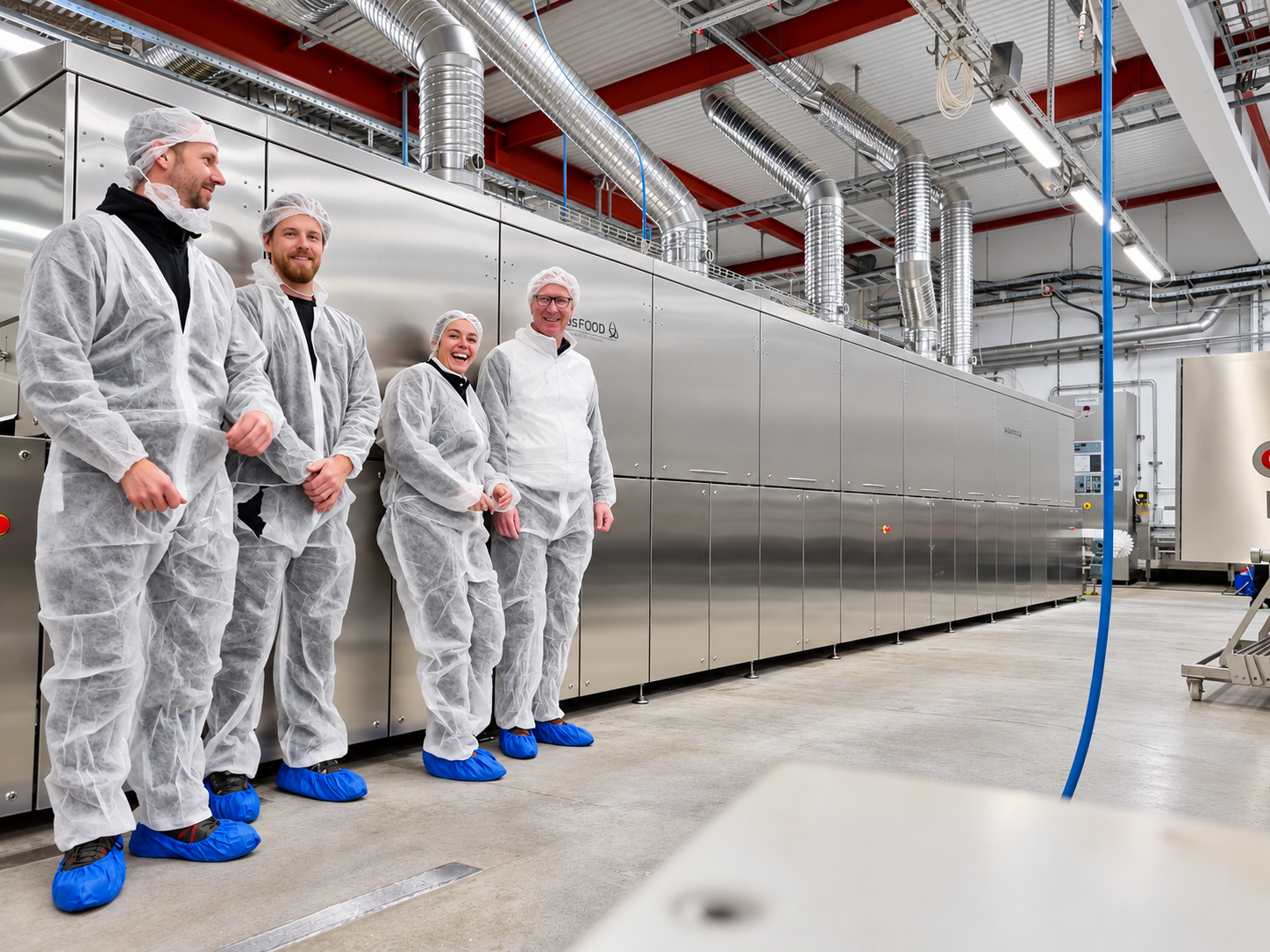
CelsiusFOOD PREMIUM Systems are purpose designed for continuous multi-shift operation, using durable materials, long-life components and serviceable mechanical and electrical solutions,

CelsiusFOOD PREMIUM Systems are purpose designed for continuous multi-shift operation, using durable materials, long-life components and serviceable mechanical and electrical solutions,
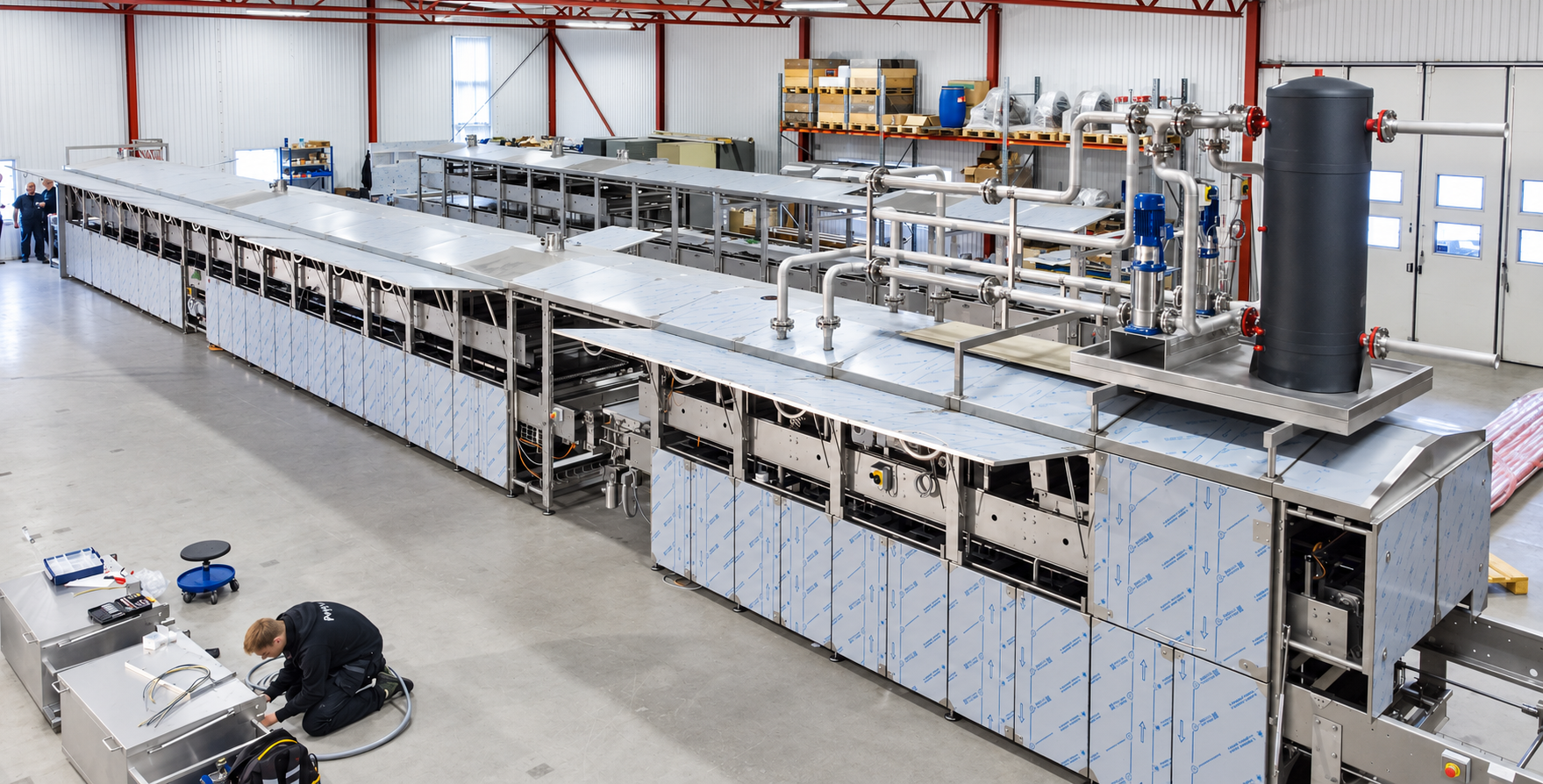
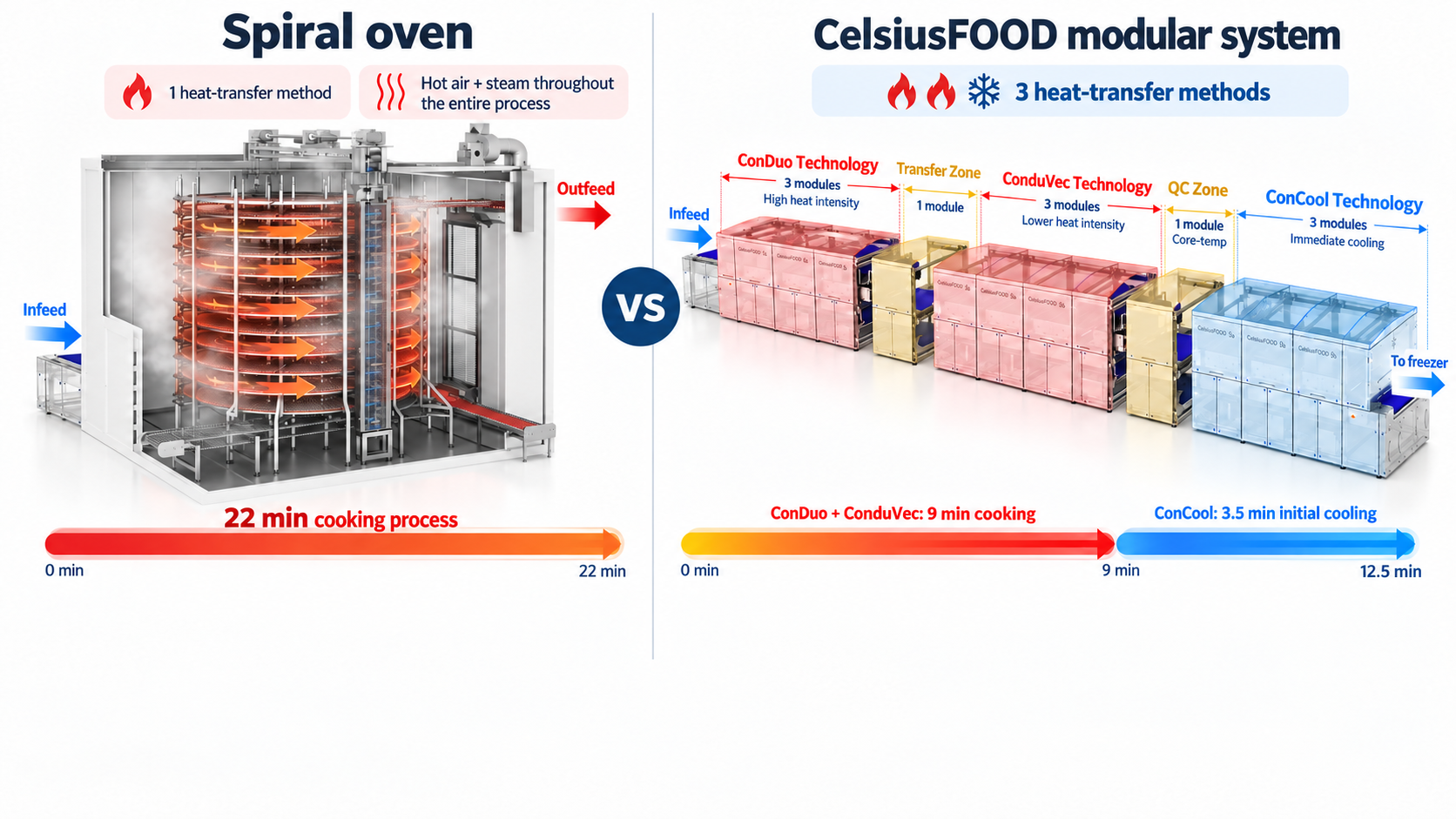
CelsiusFOOD PREMIUM Systems are built from several linear process modules. Groups of modules can use different heat-transfer technologies, allowing the thermal process to be purpose designed according to the requirements of the product at each stage,
Every minute matters in thermal processing. Faster core-temperature increase, generate less time in the high weight-loss phase which leads to lower cumulative cooking loss,
Uniformed thickness, uniformed core temperature improves you ROI. Single products in a batch contract and expand differently when heated in tunnel- and spiral ovens,
CelsiusFOOD specializes in modular and continuous thermal processing systems combining direct contact heat transfer with non-stick PTFE conveyor belts. Through continuous involvement in system design, commissioning and operation, our mechanical, electrical and software engineering teams constantly refine system design and functionality with a focus on reliability, process performance and uptime. PREMIUM Systems are purpose designed for continuous multi-shift production, with particular attention to maximizing available production time.

Many conventional tunnel and spiral -ovens use forced hot air and steam throughout the cooking process. In a CelsiusFOOD modular system, the heat-transfer method can change between process stages. For fully cooked products such as chicken breasts, thighs, inner fillets and thicker burger patties, the first stage can use ConDuo direct-contact technology to apply high heat intensity to develop the product surface and press heat into products. ConDuo increase core temperature from 2°C to 40°C (35°F to 105°F) within the first minute of processing. The product then continues on the same non-stick PTFE conveyor into the next process stage where another ConduVec technology complete the cooking process at a lower heat intensity. Where required, a subsequent cooling stage can reduce product temperature immediately after the target core temperature has been reached. This allows heating and ConCool technology for initial cooling to be integrated within the same continuous system. By using different heat-transfer methods at different stages, the process can be configured around parameters such as heating rate, surface color, target core temperature, process time, yield and downstream cooling requirements.
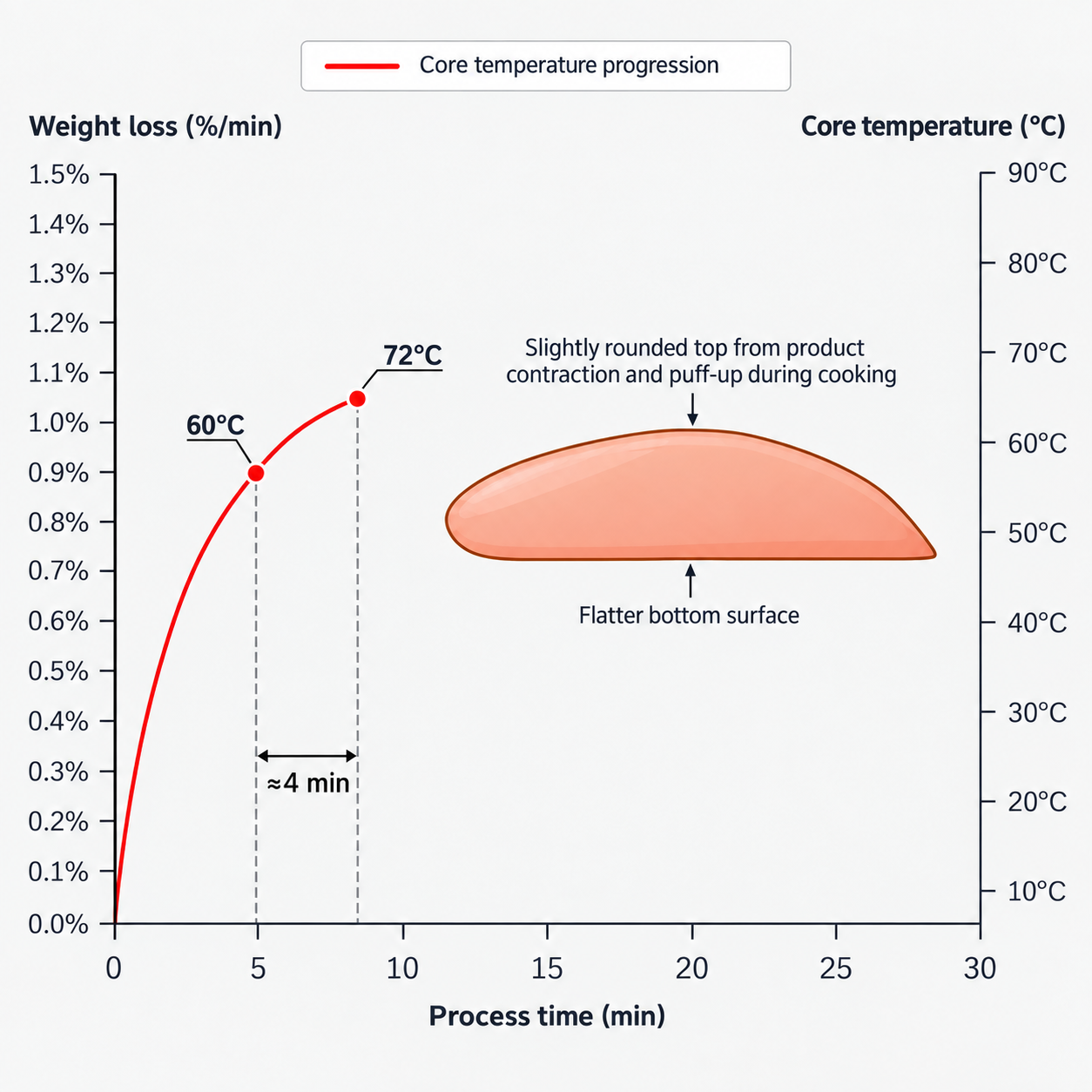
Process time has a direct influence on product weight loss during thermal processing. Weight loss is not constant throughout the cooking cycle. For RTE chicken breasts, as example, cooked in a conventional hot-air and steam oven, the core temperature initially rises relatively quickly. During the first stage of the process, from approximately 2°C to 60°C (36°F to 140°F) core temperature, the temperature increase is about 4°C (40°F) per minute, with an average weight loss of approximately 0.4% per minute up to 60°C (140°F). As the product temperature increases, the thermal conditions change. The product surface becomes hotter, the temperature difference driving heat transfer towards the core decreases, and heat must travel progressively further through the product to reach its center. Product contraction and changes in shape can further influence this heat-penetration depth. Above approximately 60°C (140°F) core temperature, the rate of core-temperature increase slows significantly. In the example shown in Fig. 1, increasing the core temperature from 60°C to 72°C (140°F to 162°F) requires about 10 additional minutes, corresponding to an average increase of only about 2.5°C (36°F) per minute. At the same time, moisture and fat losses become substantially higher above 60°C (140°F), reaching approximately 0.9–1.2% of product weight per minute during this final cooking phase. Nearly half of the total cooking time may be required for the relatively small final increase in core temperature from 60°C to 72°C (140°F to 162°F). The final cooking phase represent a higher share of the total weight loss.
Fig. 1 illustrates the relationship between process time, core-temperature progression and weight loss for RTE chicken breast cooked in a conventional hot-air and steam oven.

ConDuoVec combines two heat-transfer methods within the same continuous process. The first stage uses ConDuo technology with direct-contact heating from two sides of the products simultaneously. The second stage uses ConduVec technology, combining bottom direct-contact heating with high-temperature radiation broilers from above. This combination reduces the time required to increase the product core temperature compared with conventional hot-air and steam cooking. During the first stage, simultaneous heat transfer from both sides of products rapidly increases the product core temperature. Controlled product thickness limits changes in product thickness and maintain a consistent heat-penetration depth from the surface to the core. In the second stage, ConduVec continues the temperature increase using direct-contact heat from below and high-temperature radiation broilers from above. The process takes place without forced circulation of hot air and without the addition of steam. Static non-forced air, contrary to forced air, eliminates exposure to moving hot air and reduce excess dehydration. The core temperature increases at approximately 8°C (46°F) per minute, compared with 4°C (40°F) per minute during the conventional process. More importantly, the time spent in the final high-loss temperature range, is substantially reduced. This shorter exposure reduce the number of minutes during which moisture and fat losses are highest. The relationship between faster core-temperature development and reduced exposure to this high-loss phase contributes to higher retained product yield. In the example illustrated in Fig. 2, the chicken breast reaches a core temperature of 72°C (162°F) in 9 minutes, compared with 25 minutes in the conventional hot-air and steam process shown in Fig. 1. This corresponds to a reduction in process time of approximately 60%.
Fig. 2 illustrates the relationship between process time, core-temperature progression and weight loss for RTE chicken breast processed with ConDuoVec technology.
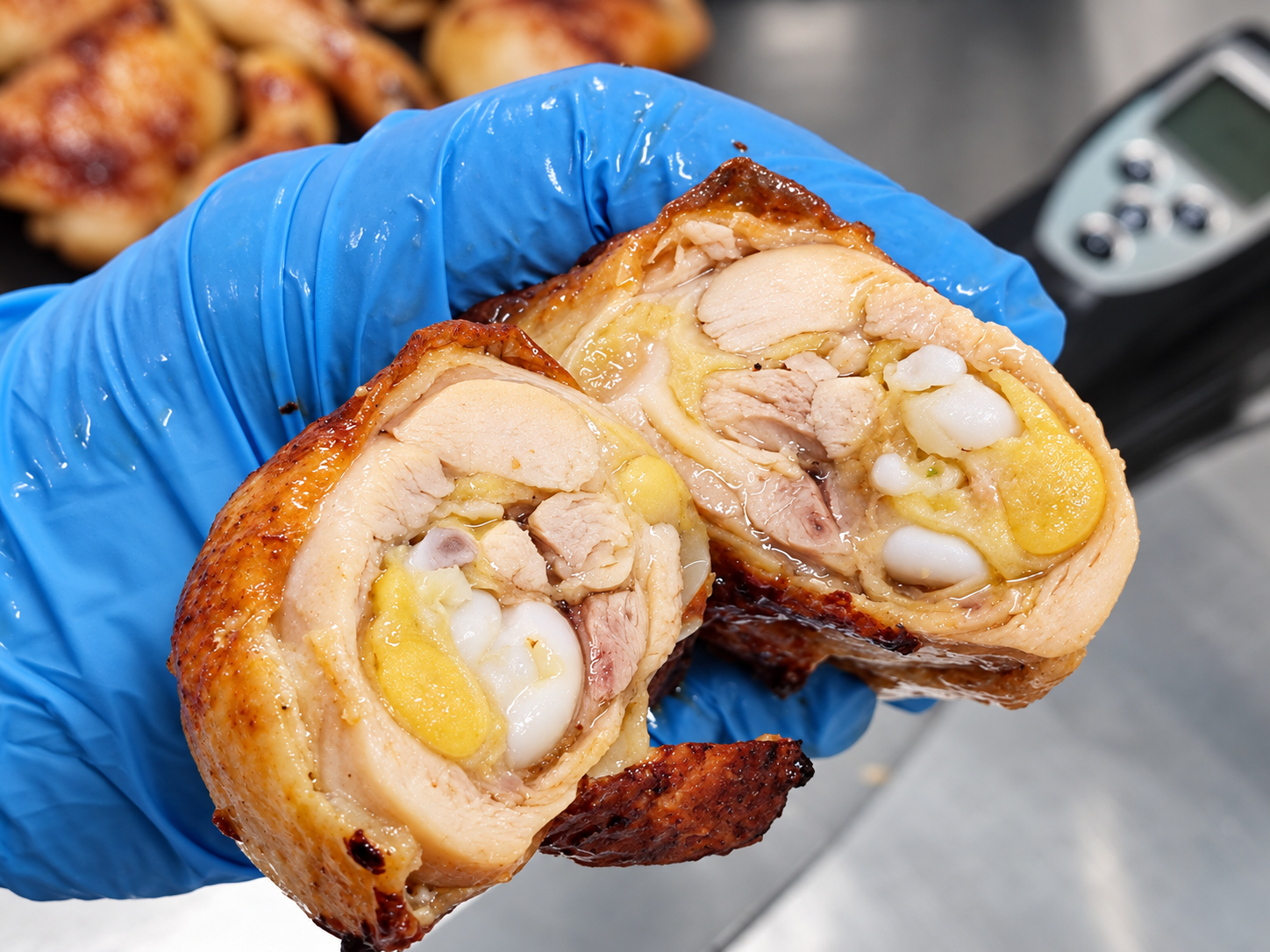
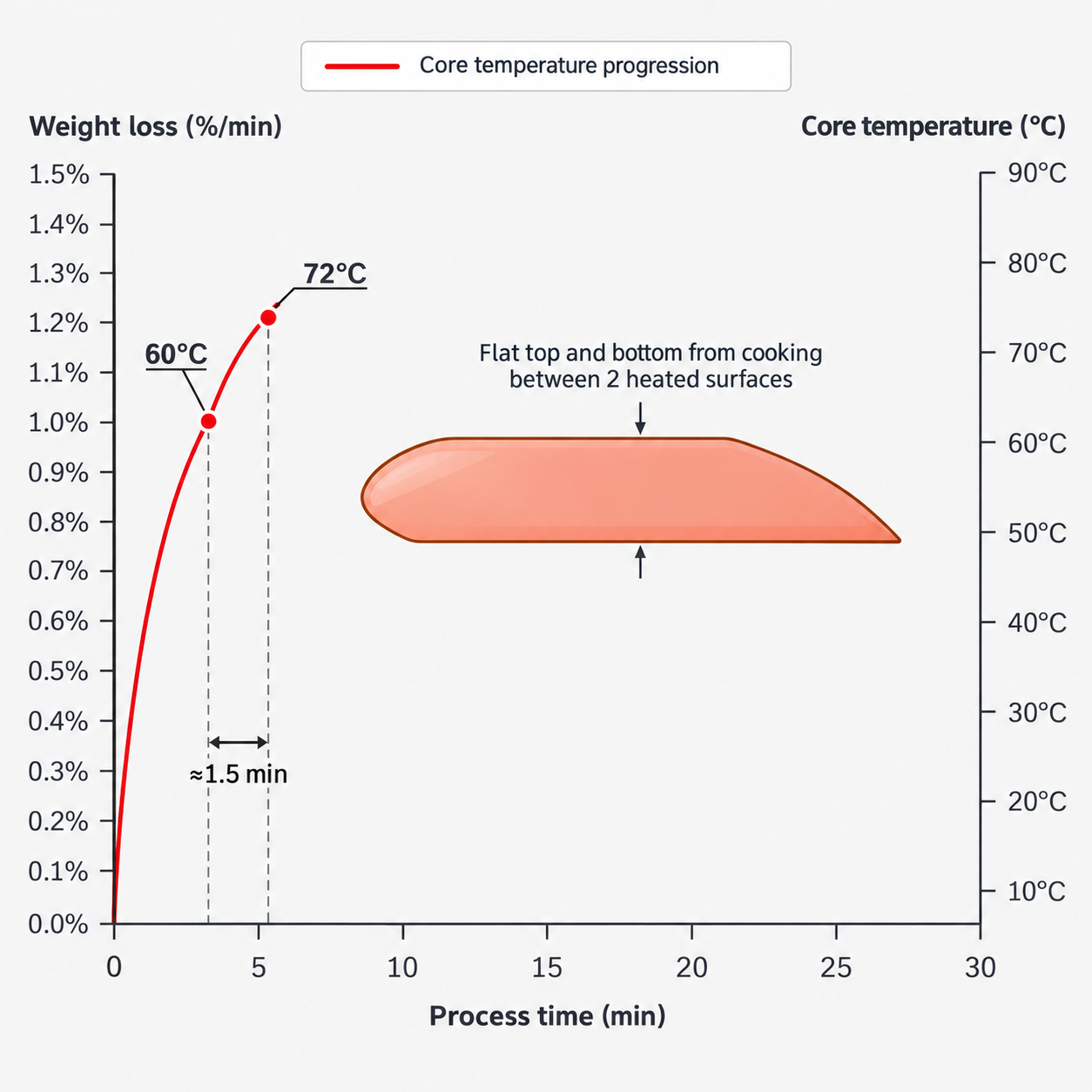
ConDuo uses simultaneous direct-contact heat transfer from two sides of the products. Products are continuously conveyed between two heated non-stick conveyors with a precisely adjustable and uniform process gap. Heat is therefore transferred directly into the product from both sides, shortening the distance that heat must travel to reach the core. The product core temperature increases at about 14°C (57°F) per minute. The critical temperature range from 60°C to 72°C (140°F to 162°F), where weight-losses increase significantly, is passed in approximately 2 minutes. The controlled gap between the two heated surfaces limits changes in product thickness during cooking. Products with variations in weight and thickness follow a consistent heat-penetration depth to the core, generating more uniform final core temperatures, reduce over-cooking and weight loss. Product that are fully-cooked with ConDuo technology only has a flatter and more consistent profile compared with products cooked without an upper contact surface. This can be particularly relevant when the cooked product are sliced, diced or portioned as RTE chicken fajita, sandwich strips or diced chicken for Cesar salad.
Fig. 3 illustrates the relationship between process time, core-temperature progression and weight loss for RTE chicken breast processed with ConDuo technology.
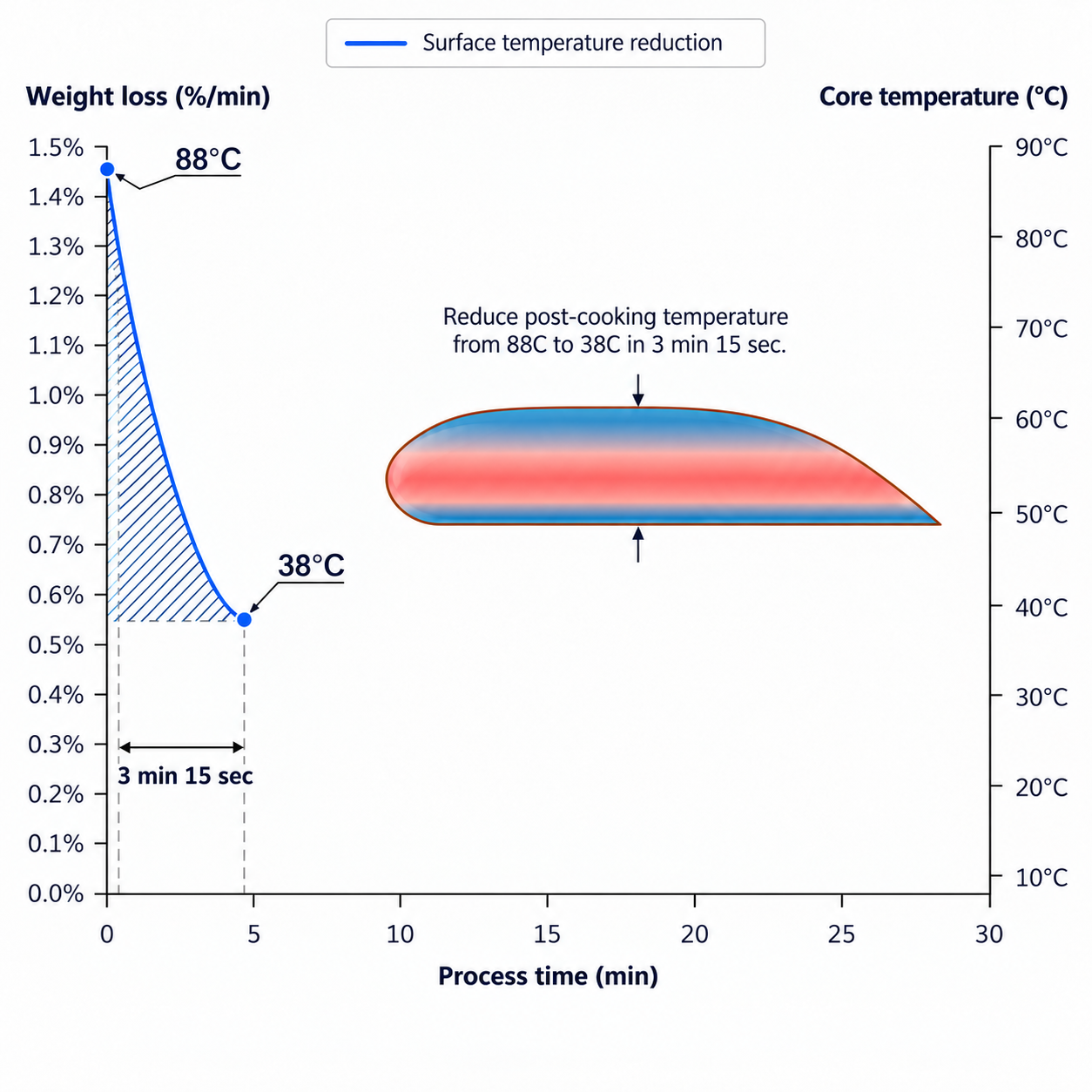
ConCool technology is integrated at the discharge end of the cooking system to reduce product temperature immediately after thermal processing and before further chilling or freezing. After products exit the cooking modules, fully-cooked products remain at elevated temperature and continue to lose juice, moisture and fat at a high rate until their temperature is reduced. Those minutes of post-cooking cause additional weight loss if products are transferred directly to cooling or freezing without an intermediate temperature-reduction step. As product temperature decreases, the rate of weight loss also falls significantly. Immediate temperature reduction after cooking therefore shortens the number of minutes during which products lose more of their weight. Temperature reduction help to limit further evaporation, drip loss and fat release before cooling or freezing. This intermediate cooling step improve the operating conditions of downstream chilling and freezing equipment. Feeding very hot products directly into a mechanical tunnel freezer, spiral freezer or impingement freezer increases the moisture load within the freezing zone. Moisture released from hot product surfaces accumulate as frost and ice on evaporator coils, reducing heat-transfer efficiency, increasing energy consumption and requiring periodic defrosting stops. By reducing product temperature before entry into a cooler or freezer, ConCool technology lowers the thermal and moisture load on the freezer. This reduce icing, maintain freezer performance and support longer continuous production runs between defrost cycles. ConCool is therefore relevant not only for retained product yield, but also for the overall efficiency of the cooling or freezing step that follows cooking.
Fig. 4 illustrates the relationship between post-cooking temperature reduction and weight loss for RTE chicken breast initially cooled with ConCool technology.
Some products will be thicker than others, causing variations in the distance from the products surfaces to their cores. These variations lead to differential core temperatures. As no single product can be under-cooked, it is that single product that decides the parameters for all the others. As example, a batch of 5000 pieces of 185 to 215 g. (6.5 to 7.6 oz) chicken breast cooked to minimum 75ºC (167ºF), 4999 breasts will reach a higher core temperature. Some smaller breasts will reach 90ºC (194ºF), while the average core temperature of the 5000 breasts will be 82.5ºC (180.5ºF). Plain chicken breasts lose about 1% more of their weight for every 2.5ºC (36.5ºF) higher than 75ºC (167ºF). The average weight loss caused by higher temperature is 4% higher than the product that reached 75ºC (167ºF). About 25% of the batch will lose 6 to 8% or more than the product that reached 75ºC (167ºF).
Cooking (fully or partially) products between two surfaces with a defined distance between, restricts the height of all 5000 breasts cooked. As example, the defined distance is set to be 28.4 mm, meaning none of the 5000 breasts will become thicker during cooking. The distance the heat travels, from the surface to the core, will be 14.2 mm for all 5000 chicken breasts. With the same minimum core temperature of 75ºC (167ºF), 4999 breasts will reach no more than 79ºC (174.2ºF). The average core temperature of the 5000 breasts will be 77ºC (170.6ºF). The average weight loss caused by higher temperature is less than 1% higher than the product that reached 75ºC (167ºF). About 25% of the batch will lose 1 to 2% or more than the product that reached 75ºC (167ºF).
The batch of 5000 chicken breasts cooked between two surfaces, have 4.375% higher retained yield than the batch cooked is tunnel- or spiral oven. (1+0.375) 1.375% - (4+1.75) 5.75% = 4.375%.
| Production throughput | Additional retained weight per hour | Additional sellable weight per 8-hour shift | Additional sellable weight per 16-hour shift |
|---|---|---|---|
| 500 kg (1100 lb) / h | 21.9 kg (48 lb) | 175 kg (386 lb) | 350 kg (772 lb) |
| 1000 kg (2200 lb) / h | 43.8 kg (97 lb) | 350 kg (772 lb) | 700 kg (1543 lb) |
| Calculated using 4.375% increase in retained yield compared with tunnel- or spiral oven using hot air and steam for heating. | |||
Food products contract, expand or change thickness during heating. Chicken breasts, meat cuts and formed products may therefore develop different product thicknesses during cooking when no defined process gap limits vertical expansion.
Return on Investment calculations are an important part of any equipment investment decision. Before calculating ROI, the process should first be tested and the expected results verified under repeatable conditions to establish reliable input data.
The CelsiusFOOD PREMIUM range are purpose designed systems based on five modular thermal technologies. Systems are available in three effective process widths: 600 mm (24 in), 1000 mm (40 in) and 1200 mm (48 in).
CelsiusFOOD PREMIUM Systems are modular and can be extended or reconfigured as production requirements change. Capacity can be increased and additional heat-transfer technologies can be integrated without replacing the complete system.
Contrary to open metal mesh conveyors, solid non-stick PTFE coated conveyor belts prevent proteins and marinades from sticking. Fat and drippings remain on the solid conveyors for continuous collection. The absence of industrial conveyor belt marks underneath products enhances a home-cooked appearance.
CelsiusFOOD is specialized in one field, continuous thermal processing using direct-contact heat transfer and solid non-stick conveyor belts, commonly referred to as Belt-Grills, Twin Grills, Contact Cookers and Combi Cookers.
In a batch of 2000 kg (4000 lb) uncalibrated chicken breasts, the largest or thickest products determine the required cooking time, as they need more time to reach the target core temperature. These products represent only a small proportion of the total batch, meaning the majority of smaller products will remain in the heating process longer than necessary. This result in higher final core temperatures and increased cooking losses for the smaller, lighter or thinner products. Continuous cooking between two solid non-stick conveyors establishes a defined maximum product thickness throughout the heating process. The controlled gap limits thickness variation independently of individual product size and weight. A consistent product thickness creates a uniform heat-transfer distance from the product surfaces to the core for all products in the batch. This produces more consistent final core temperatures across the production flow and eliminates over-cooking and excess weight loss across a batch.
| Chicken breast groups | Raw kg | Core temp. | Retained yield | Cooked kg/lbs |
|---|---|---|---|---|
| 200–205 g | 100 | 86–90°C | 73.0% | 73.0 |
| 205–210 g | 180 | 84–88°C | 74.6% | 134.3 |
| 210–215 g | 300 | 83–86°C | 76.2% | 228.6 |
| 215–220 g | 400 | 80–84°C | 77.8% | 311.2 |
| 220–225 g | 400 | 78–82°C | 79.4% | 317.6 |
| 225–230 g | 320 | 76–80°C | 81.0% | 259.2 |
| 230–235 g | 240 | 74–78°C | 82.6% | 198.2 |
| 235–240 g | 60 | 76–78°C | 84.2% | 50.5 |
| TOTAL | 2,000 | 78.6% avg. | 1,572.6 (3467 lbs) |
| Chicken breast groups | Raw kg | Core temp. | Retained yield | Cooked kg/lbs |
|---|---|---|---|---|
| 200–205 g | 100 | 76–78°C | 87.4% | 87.4 |
| 205–210 g | 180 | 76–78°C | 86.6% | 155.9 |
| 210–215 g | 300 | 76–78°C | 86.6% | 259.8 |
| 215–220 g | 400 | 76–78°C | 85.8% | 343.2 |
| 220–225 g | 400 | 76–78°C | 85.8% | 343.2 |
| 225–230 g | 320 | 76–78°C | 85.8% | 274.6 |
| 230–235 g | 240 | 76–79°C | 85.0% | 204.0 |
| 235–240 g | 60 | 76–79°C | 85.0% | 51.0 |
| TOTAL | 2,000 | 85.9% avg. | 1,719.1 kg (3790 lbs) |
ROI scenarios vary considerably between companies, depending on production conditions, product value, operating costs and the parameters included in the calculation. In its simplest form, ROI can be expressed as the payback period generated by increased sellable output through higher retained yield. A more complete assessment also considers Cost of Operation (CoO). Depending on the application, CoO may include energy consumption, labor, cleaning, maintenance, consumables, production losses, uptime and other operating factors. The two metrics below provide an overview of how ROI and CoO can be evaluated.
| Grilled chicken breasts | Old oven | CelsiusFOOD oven | Difference |
|---|---|---|---|
| Raw material/year | 4.320.000 kg | 4.320.000 kg | Same |
| Finished yield | 78.6% | 82.8% | +4.2% |
| Finished product/year | 3.395.520 kg | 3.576.960 kg | +181.440 kg |
| Net value per extra kg | – | €6.20/kg | – |
| Annual gain | – | – | €1.124.928/year |
| Investment | – | – | €926.000 |
| Payback | – | – | >10 months |
| Metric | Old oven | CelsiusFOOD oven | Difference / Saving |
|---|---|---|---|
| Production/year | 4.320.000 kg | 4.320.000 kg | Same |
| Throughput | 900 kg/h | 1150 kg/h | +250 kg/h |
| Annual operation time | 4.800 h/year | 3.757 h/year | -1.043 h/year |
| Operation time reduction | – | – | -21.7% |
| Operators required | 4 | 4 | Same, fewer hours |
| Manager required | 1 | 1 | Same, fewer hours |
| Total labor cost per hour | €268/h | €268/h | Same |
| Annual labor cost | €1.286.400 | €1.006.876 | +€279.524 |
| Energy cost/kWh | €0.20 | €0.20 | €0.20 |
| Oven energy (+4.2% yield) | 0.271 kWh/kg | 0.237 kWh/kg | -0.034 kWh/kg |
| Oven energy annual | 1.170.720 kWh | 1.023.840 kWh | -146.880 kWh |
| Oven energy annual cost | €234.144 | €204.768 | +€29.376 |
| Factory lightning | 57.600 kWh | 45.084 kWh | -12.516 kWh/year |
| Factory lightning cost | €11.520/year | €9.017/year | +€2.503/year |
| Total energy cost | €245.664/year | €213.785/year | €31.879/year |
| Total labor & energy cost | €1.532.064/year | €1.220.661/year | +€311.403/year |
Each linear process module is 1000 mm (3.3 ft) long. PREMIUM Systems are available in process lengths from 3 to 15 meters (10 to 50 ft) in 1-meter modular increments. Systems combining two or more thermal technologies can be configured with longer total process lengths where so is required by the application. Heating can be supplied by thermal fluid, electric heating or a combination of both depending on the system configuration. ConCool technology use either propylene glycol or chilled water as the cooling medium.
| Modular thermal technologies | Heating and cooling media |
|---|---|
| ConDuo | Thermal Fluid or Electric heating |
| ConduVec | Thermal Fluid or Electric heating |
| ConUno | Thermal Fluid or Electric heating |
| ConVec | Electric heating |
| ConCool | Propylene glycol or ice water cooling |
| Effective Process Widths | Effective Process Lengths |
|---|---|
| 600 mm (24”) | 3 m (10 ft) |
| 1000 mm (40”) | 4 m (13 ft) |
| 1200 mm (48”) | 5 m (16 ft) |
| 6 m (20 ft) | |
| 7 m (23 ft) | |
| 8 m (26 ft) | |
| 9 m (30 ft) | |
| 10 m (33 ft) | |
| 11 m (36 ft) | |
| 12 m (39 ft) | |
| 13 m (43 ft) | |
| 14 m (46 ft) | |
| 15 m (50 ft) |
For new products and market introductions, ConDuo technology is available in four smaller system sizes with capacities ranging from approx. 50 to 450 kg/h (110 to 1,000 lb/h). Starting with a smaller ConDuo system reduce the initial investment while production volumes and market demand are still developing. The same process principles, parameters and product results apply across all ConDuo system sizes. This allows new products to be developed on a smaller system and transferred when production is scaled to higher industrial volumes. Products can therefore be introduced, and production experience established, before investment in a larger-capacity system.
CelsiusFOOD PREMIUM Systems provide a second approach to managing future capacity requirements. The systems are built from individual linear modules assembled one after another. A modular system can initially be configured for the capacity required today and extended later by adding further modules. Additional modules can use the same heat-transfer technology to increase capacity, or different technologies can be integrated when the process or product range changes. This modular approach reduces the need to invest upfront in additional capacity for future production volumes or product requirements that are not yet defined.
PTFE conveyor belts are manufactured and certified according to EC 2023/2006, materials intended to come in contact with food. They undergo migration tests for tetrafluoroethylene. PTFE intended for food contact use shall not be mistaken with non-food PTFE used in clothes, fire suppression foams, cosmetics, sun cream, insulation, etc.
The service life of PTFE conveyor belts depends on several factors, among them operating temperature, method of belt-cleaning and the characteristics of the food products being processed. Ingredients such as starches, proteins and sugars can significantly affect the service life. This means replacement intervals may vary considerably between applications. As a general indication, PTFE belts used with ConDuo technology typically require replacement after approximately 300 operating hours, while a service life of around 600 operating hours is common with ConduVec technology.
The hourly throughput, type of products and the replacement intervals varies considerably. As a general indication for common food products produced by the ConDuo technology like beef burgers, chicken parts, pork chops, sausages, salmon steaks, etc., the cost per kilo raw material infeed is about 0.0019€ per kilo ($0.0010 per lb raw product).
Rather than supplying a broad portfolio of equipment, we concentrate our resources on developing, improving and supporting this technology. This focus allows knowledge to build continuously across food applications, mechanical and electrical design, software and after-sales service. CelsiusFOOD operates three product divisions covering PREMIUM Systems and STANDARD Systems for food industry and Twin-COOK systems for small to medium production capacities. Across these divisions, the underlying process technology and expertise remain closely connected.
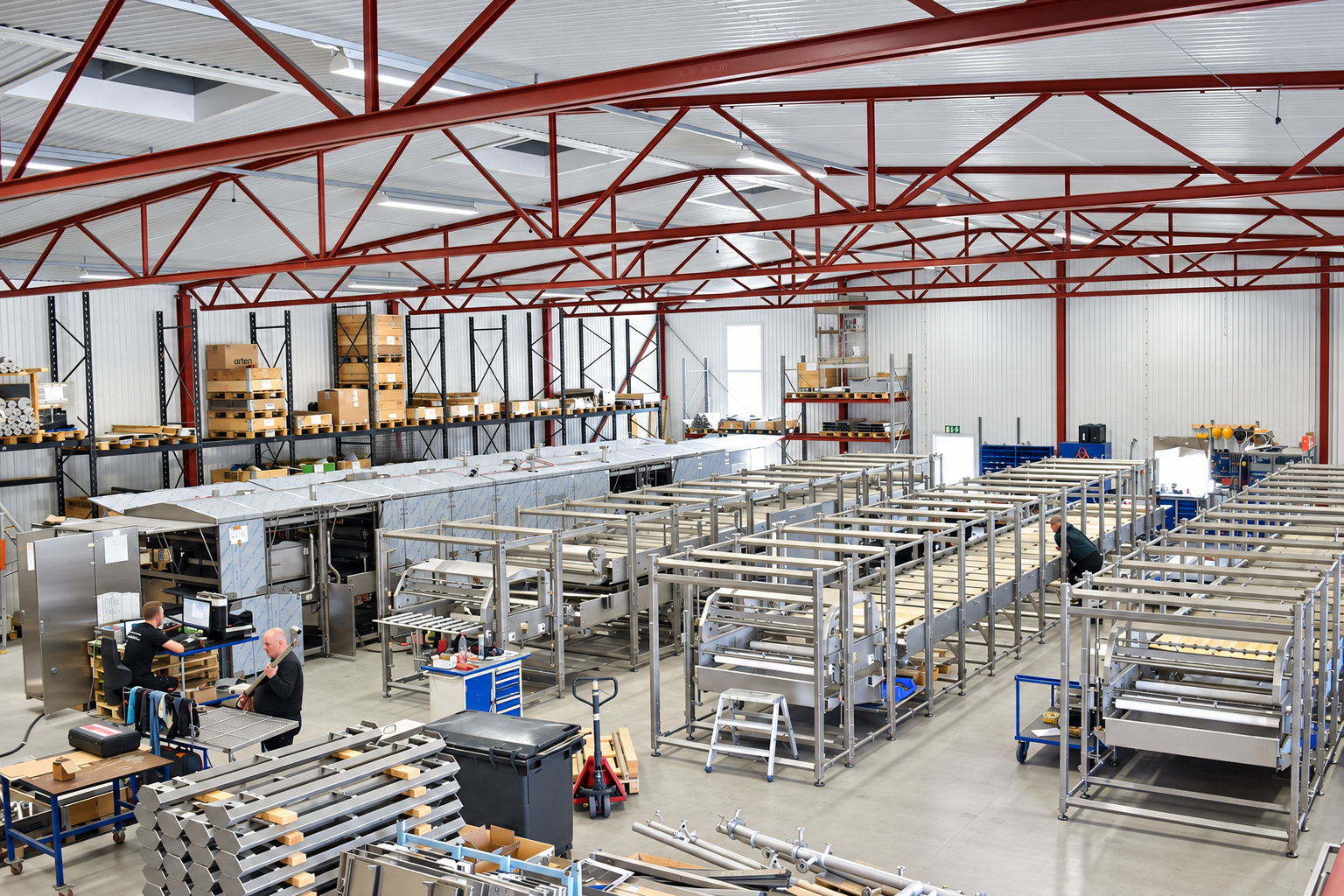
Our expertise is developed in two complementary areas. At the CelsiusFOOD Food Technology Test Center in France, the focus is on food applications, process development, product behavior, cooking parameters, yield, appearance and process validation. At our Technical Operations in Sweden, the focus is on mechanical and electrical engineering, software development, manufacturing, system reliability, maintenance and continuous technical improvement. Both areas work around the same core technology. Feedback from food trials, customer installations, service activities and on-site operational experience is continuously transferred back into product development. By concentrating on this specific process technology, we develop deeper application and technical knowledge, improve system performance over time and provide customers with solutions based on direct experience with the equipment we design, manufacture and support.