Discover the engineering
behind our technologies.

Explore the precision components, advanced engineering and innovative processes behind CelsiusFOOD PREMIUM Systems.

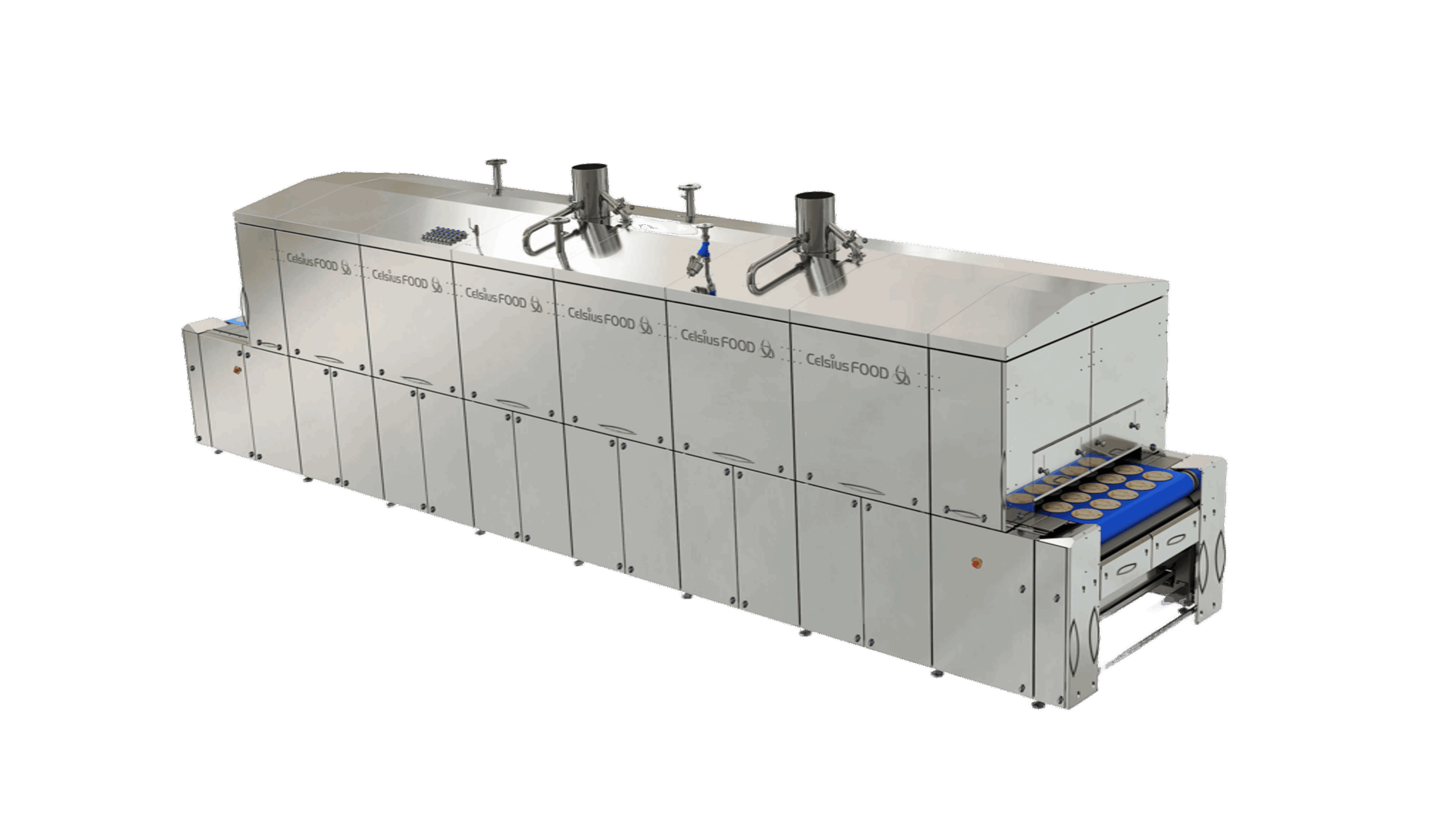
CelsiusFOOD industrial cooking equipment

Technology & Engineering

Explore the precision components, advanced engineering and production processes behind CelsiusFOOD PREMIUM Systems.

01 / Heating & Precision

Electrical Heating Plates

Electrically heated stainless-steel plates engineered and manufactured for durability.

Electrical heating plates consist of a solid stainless-steel enclosure with enclosed conductors and heating elements.

The durable material withstands brushing, scraping and daily washing with alkaline detergents. All components inside and outside the heated plates are replaceable to keep maintenance costs down.

260°C Maximum temperature (500°F)
3 widths 600, 1000 and 1200 mm

Thermal Fluid Heating Plates

Thermal fluid heated stainless-steel plates, standard for products thicker than 6 mm.

Thermal fluid (thermal oil) heated plates are made entirely of stainless steel.

260°C Maximum temperature (500°F)
>6 mm Product thickness
3 widths 600, 1000 and 1200 mm

High Precision Heating Plates

High-precision thermal fluid heated plates specially made for RTE bacon and thinner products.

These plates are engineered to resist convex and concave deformation and maintain a stable thermal response.

Designed to remain flat and dimensionally stable at high operating temperatures, they help maintain process accuracy during continuous production.

They are fitted to systems requiring high precision together with a high-precision hoist system, for example ConDuo TF BC systems.

260°C Maximum temperature (500°F)
3 widths 600, 1000 and 1200 mm

Hoist System with High Accuracy

High-precision hoist system for thin products where 0.1 mm can affect the product result.

High-precision hoist systems are made entirely of stainless-steel components.

The design, encoders, gears, couplings and lead screws are optimized to maintain accuracy.

The high-precision hoist system is fitted to systems with high-precision thermal fluid heating plates, for example ConDuo TF BC systems.

0.1 mm A small difference that can affect the result for thin products.
02 / Production Equipment

Continuous Belt-Washing

Steam belt-washers help reduce fresh water, wastewater and energy consumption.

CelsiusFOOD PREMIUM Systems are fitted with Generation 6 belt-washers using steam for effective cleaning.

CelsiusFOOD steam belt-washing technology reduces fresh water use from approximately 1,200 L (320 US gal) to only 50 L (13 US gal) per hour compared with conventional hot-water belt-washers.

This represents up to 96% less fresh water consumption and up to 96% less wastewater.

By replacing large volumes of 55°C (130°F) washing water with steam-cleaning, CelsiusFOOD systems reduce the thermal energy required for continuous belt-washing, lowering operating costs in high-volume production.

Heating 1,200 L (320 US gal) of incoming water per hour from 15°C to 55°C (60°F to 130°F) requires 56 kWh of energy just to heat the washing water.

96% Up to 96% less fresh water
50 L/h CelsiusFOOD PREMIUM
1,200 L/h Conventional belt-washer

Water Consumption Comparison

Per hour of production Industry Standard CelsiusFOOD PREMIUM Saving
Fresh water use 1,200 L (320 US gal)/h 50 L (13 US gal)/h 1,150 L (304 US gal)/h saved
Wastewater generated 1,200 L (320 US gal)/h 5–15 L/h (4 US gal)/h 1,185 L (313 US gal)/h less wastewater
Water reduction – – 96% less

Annual Water Savings

Annual operation Fresh water saved Wastewater reduced
2,000 h/year 2,300,000 L (607,595 US gal)/year 2,370,000 L (626,088 US gal)/year
4,000 h/year 4,600,000 L (1,215,190 US gal)/year 4,740,000 L (1,252,175 US gal)/year
6,000 h/year 6,900,000 L (1,822,787 US gal)/year 7,110,000 L (1,878,263 US gal)/year

Enlarged Drive Units

Heavy-duty, oversized drive units engineered for stable belt traction in demanding production conditions.

CelsiusFOOD Mega-Drive Units maintain stable belt traction between glossy conveyors and drive rollers.

They are engineered to prevent belt slippage, helping maintain accurate process time and avoid product congestion on the infeed.

The integrated CIP system allows efficient cleaning of the drive rollers.

Powerful, fully enclosed and ventilated motor units ensure reliable performance in demanding production environments.

With drive data presentation and a heavy-duty design, Mega-Drive Units are the standard choice for larger bacon processing systems.

Continuous Fat Collection

Integrated collection solutions for rendered fat and cooking drippings.

Processing large volumes of products that release considerable amounts of rendered fat during heat-up requires effective collection and disposal solutions.

An integrated collection system prevents rendered fat and drippings from being wasted on the floor.

Rendered pork fat retains its value when properly collected and can often be sold for further use.

When larger volumes of ground beef (minced meat) are cooked, the solid non-stick belts retain the rendered fat. At the system exit, the fat is separated and collected.

A significant proportion of the collected fat can be reincorporated into fully cooked, ready-to-eat ground beef.

15%+ Potential yield increase when recovered fat is reincorporated into RTE ground beef.
03 / Thermal Processes

Direct Contact Heat Transfer

Simultaneous heat transfer from both sides shortens process time for products thinner than approximately 30 mm (1.2 in).

Cooking 11 mm (0.43 in) thick burger patties on a tabletop requires approximately 4.5 minutes, or slightly more than 2 minutes per side.

When direct contact heat is applied simultaneously from both sides, process time is 55 seconds.

Natural chicken breasts weighing 200 g (7 oz) reach 74°C (165°F) in under 5 minutes, compared with 16 to 24 minutes in a hot-air steam oven.

Sliced RTE bacon requires 20 to 45 seconds, depending on the desired level of cook-out, color and crispness.

55 sec 11 mm burger patties
<5 min 200 g chicken breasts to 74°C
20–45 sec Sliced RTE bacon

Dry Cooking vs. Wet Cooking

Understanding the effects of steam, moisture and static dry heat on yield, browning and product appearance.

Steam is frequently added to the air in ovens using fans to force air through heat-exchangers.

Moisture in the closed loop evaporates when moist air passes through a heat-exchanger, resulting in drier air.

Steam is added to reduce dehydration, much as a hairdryer illustrates how effectively moving hot air removes moisture.

Adding steam can increase retained yield for many products. However, wet cooking does not aid browning.

Steam can wash off marinades and coatings and generate a pale product appearance.

Static dry heat uses non-moving air and does not force air and moisture through heat-exchangers.

Therefore, no additional steam needs to be added. This avoids associated steam costs, energy use and interference with the Maillard reaction.

Dry static air, often combined with direct-contact heat, supports broiling, searing and roasting in shorter process times.

04 / Temperature Management

Immediate Pre-Cooling

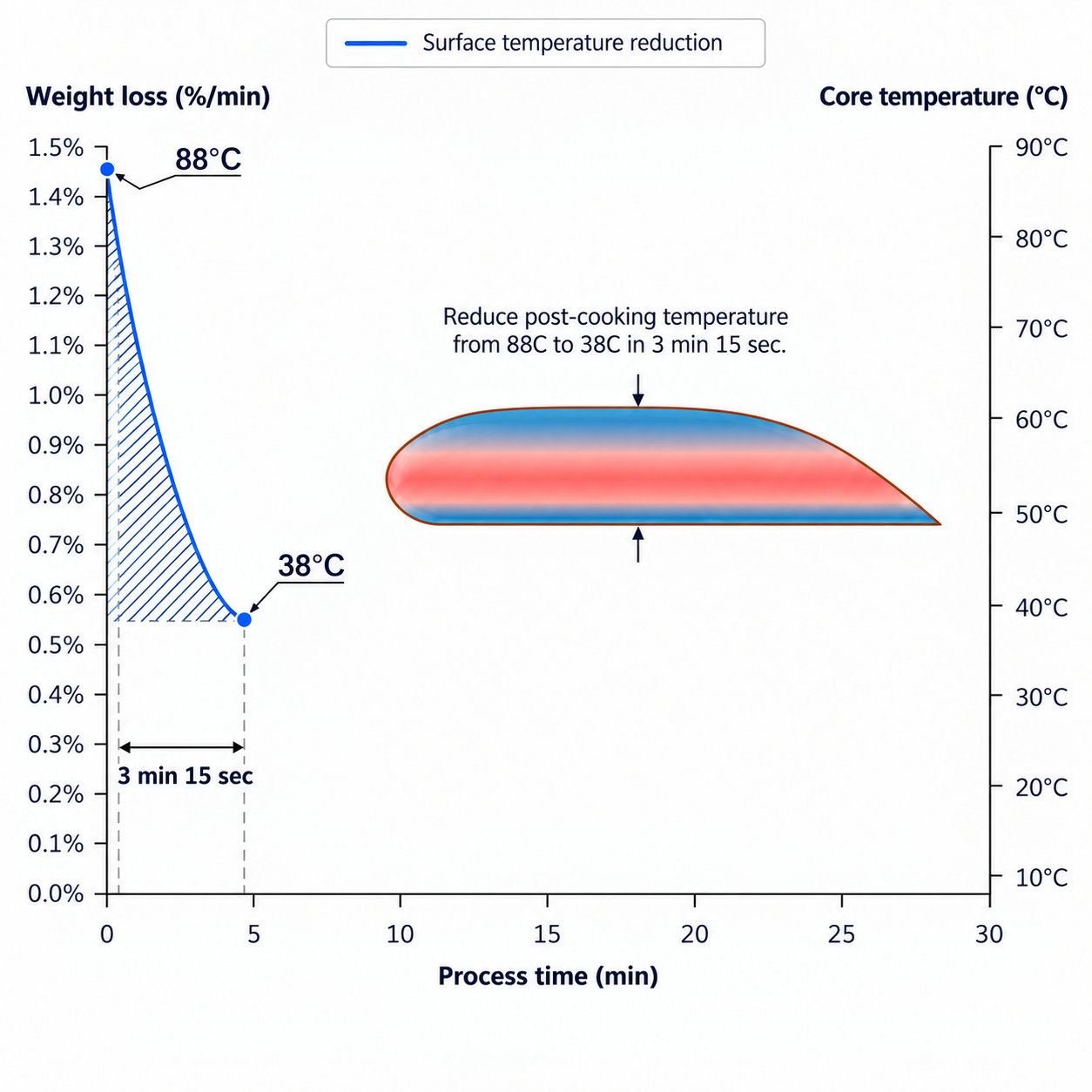
Fast temperature reduction immediately after cooking to help limit weight loss.

Higher product temperatures after cooking cause higher weight loss per minute.

Reducing cooked product temperatures to approximately 40°C (100°F) immediately after cooking, before the chiller or freezer, reduces product leakage and evaporation.

~40°C Target temperature before chilling or freezing.
CelsiusFOOD immediate pre-cooling equipment

Do you have a food processing project?

Let’s discuss your needs and create a tailored solution together.